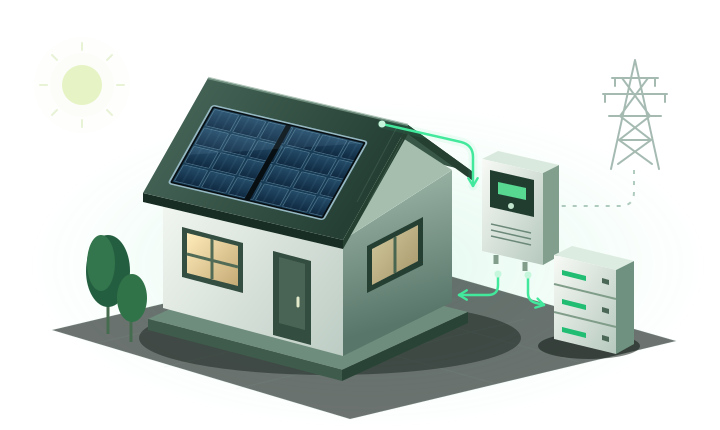
Use more of your rooftop solar, plan backup for essential circuits, or assess a small-business system. Zhengzhou ELECNO helps you narrow the inverter choice around how your site actually uses power.
System concept only. Connections, protection and operating modes depend on the exact model and site design.
Find your starting point
Different sites. The right questions first.
These are planning scenarios, not guaranteed system packages. Final selection needs the installation country, electrical service and exact battery and load details.
01 / Residential solar
Make rooftop solar part of everyday life.
A hybrid inverter can coordinate PV, a compatible battery and household loads. A system designed around your daily use can shift available solar energy into the hours when you need it.
Review daytime consumption and evening demand.
Check roof space, PV strings and cold-weather open-circuit voltage.
Confirm battery charge limits and permitted grid-export settings.
Savings depend on solar yield, tariffs, demand and system settings. Grid export needs local approval and model-specific support.
02 / Essential-load backup
Plan for the circuits that matter most.
Start with a defined list: lighting, communications, refrigeration and other essential circuits. Separate backup demand from whole-home demand before selecting the inverter and battery.
List running watts and motor or compressor starting loads.
Define the required backup duration and usable battery energy.
Confirm backup output, transfer behavior and protection design.
A hybrid label does not guarantee whole-home backup or UPS-grade continuity. Check the exact model before connecting sensitive or critical equipment.
03 / Small-business energy
Match solar to the working day.
Shops, small offices and selected workshop loads may have useful overlap between operating hours and solar production. Evaluate the load profile before deciding whether storage or backup belongs in the project.
Record opening hours, daily demand and major starting loads.
Identify the site phase arrangement and loads on each phase.
Check installation conditions, local rules and expansion needs.
A 16kW rating alone does not establish motor-start capability, permitted phase imbalance or commercial installation compliance.
From scenario to specification
Four details for a better shortlist.
No exact model in mind? Send what you know. Identify missing information before committing to a system.
01
Your electrical service
Country, grid voltage, frequency, phase and any export restrictions.
02
Your load schedule
Running power, largest starting load, essential circuits and backup hours.
03
Your PV and battery
Panel and string data, battery model, voltage, current limits and BMS protocol.
04
Your project scope
Quantity, installation environment, target schedule and required documentation.
Before you specify
Common application questions.
These checks help distinguish a suitable system from a model with the right power rating alone.
Can one system provide solar self-consumption and backup?
It may, when the exact inverter supports the required operating modes and the battery, backup circuits and protection are designed accordingly. Confirm the backup output rating and permitted wiring arrangement; do not assume every load remains powered during an outage.
Will a 48V battery work with any 48V hybrid inverter?
No. Nominal voltage is only a starting point. Check the battery operating-voltage range, continuous and peak current, supported BMS protocol, cable pinout and firmware. CAN or RS485 ports alone do not establish compatibility.
How much battery capacity do I need for backup?
Start with average essential-load power multiplied by the required hours. Then account for conversion losses, usable capacity, reserve settings and the battery's discharge limits. Motor starting and simultaneous loads also need a separate power check.
Can these inverters power a workshop or a larger building?
Some small-business applications may fit the documented range, subject to engineering review. Verify total and per-phase loads, starting currents, supply arrangement and local requirements. Do not assume a residential model or parallel capability is suitable for every commercial or industrial project.
Let's review your application
Tell us what you want to power.
Share your country, electrical service, PV and battery details, and the loads you need to support. We can use that information to discuss a suitable model shortlist.
With your permission, we use Google Analytics to understand page visits and inquiry-button use. We do not send your form answers to analytics. You can change your choice using Analytics preferences in the footer. Privacy policy